



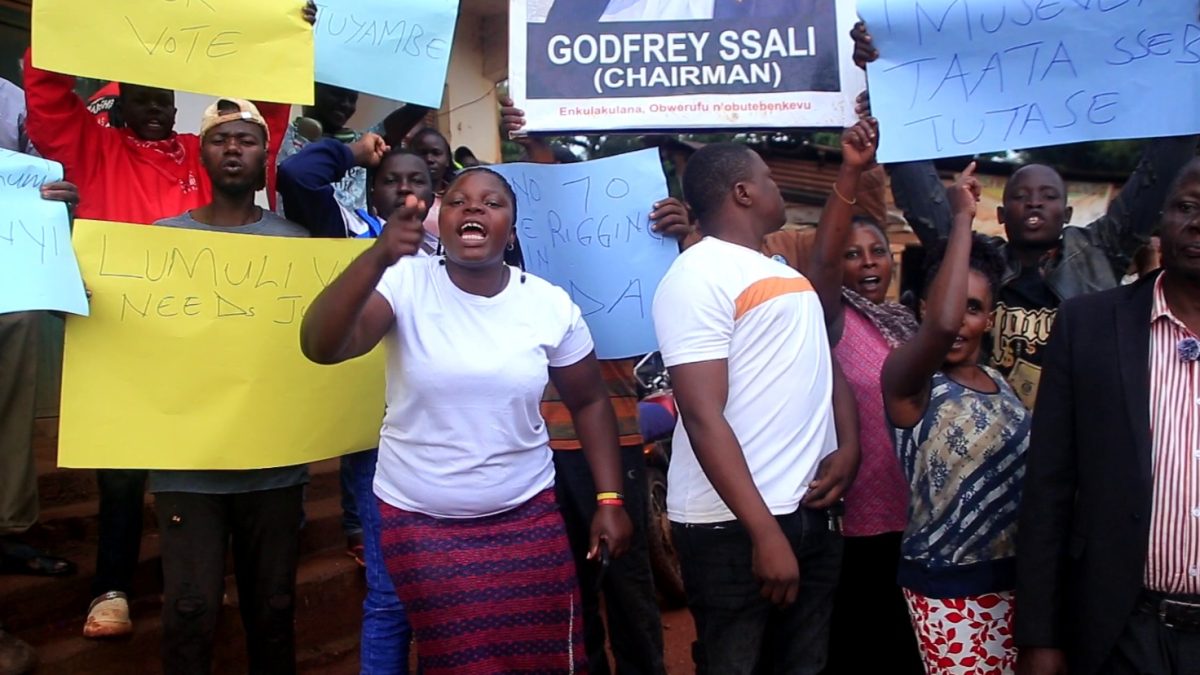
Deep in Kitende Parish, Kajjansi Town Council, Wakiso District, sits a small community whose trust in Uganda’s grassroots democratic process has been badly shaken. Residents of Lumuli Village say they watched their local LC1 election play out in plain sight, cast their votes in overwhelming numbers for their preferred candidate, and then watched in disbelief as a different man was handed the victory, not at the polling ground, but allegedly at the nearest police station.

The Numbers That Sparked a Crisis
According to the residents’ account, the tallies from the Lumuli LC1 poll were not even close. Independent candidate Ssali Godfrey reportedly pulled in 400 votes. His opponent, Tushabilihamye Edison of the NRM, received 49. In any functioning electoral system, that is a landslide with no room for interpretation. But the result, residents allege, was reversed at Lumuli Police Station, where Edison was declared the winner.
The story, as reported by NTV Uganda, captures a community that feels not just cheated at the ballot box, but abandoned by the very institutions meant to protect their civic rights.
Who Do the Residents Hold Responsible?
The allegations point fingers at a broad network of actors. Lumuli residents name the area councillor, the Resident District Commissioner (RDC), police officers, prison officers, and members of the armed forces as having played a role in facilitating the disputed outcome. The claim is serious: that state-adjacent and security forces coordinated to override the popular vote at a local level, the most intimate tier of Uganda’s governance structure.
LC1 councils are the foundation of Uganda’s decentralised government system. They handle day-to-day community matters, mediate local disputes, and act as the first point of contact between ordinary citizens and the state. When that layer is compromised, the effects ripple upward through the entire civic chain. A community that cannot trust its LC1 election is a community that has been shut out from the bottom rung of governance.
Security Forces and Electoral Integrity: A Recurring Tension
The alleged involvement of police, prison officers, and armed forces in an LC1 result is not something that can be waved away as a clerical error or a miscommunication. If the claims hold up, they represent something far more troubling: the weaponisation of security infrastructure against the democratic will of ordinary Ugandans in their own village.
Uganda has long grappled with questions about the role of security services during elections. At the national level, concerns about uniformed personnel near polling stations have surfaced repeatedly over the years. The situation in Lumuli suggests those pressures may filter all the way down to the hyper-local contests that most outside observers never track.
A Complaint Filed, and Then the Waiting Began
Lumuli residents say they did what they were supposed to do. They filed a formal complaint with the Electoral Commission. And then they waited. Weeks turned into what the community describes as a prolonged silence, with no clear indication of when, or whether, justice would arrive.
The Electoral Commission of Uganda holds the constitutional mandate to oversee elections at all levels, including LC1 contests. Its credibility depends, in part, on its responsiveness when those elections are challenged. A delayed investigation into a complaint this specific, with numbers this stark, does little to reassure communities that the system is working in their favour.
The Broader Stakes for Grassroots Democracy
It would be easy to dismiss an LC1 dispute in a single village as a minor footnote. But the integrity of local elections is the bedrock of public confidence in the wider political process. When voters in Lumuli turn out in large numbers for a candidate and allegedly see their choice erased, the message absorbed is a corrosive one: that participation does not matter, that votes can be rewritten, and that complaining through official channels may lead nowhere.
That message, if left unchallenged, breeds political disengagement. It tells communities that their voice stops at the ballot paper, rather than carrying forward into governance.
What Lumuli Deserves Now
The residents of Lumuli Village have been patient. They cast their votes. They documented the alleged discrepancy. They raised their concerns through the proper channels. At this point, the Electoral Commission owes them a transparent, timely response. An investigation that names suspects, examines the chain of custody for those vote tallies, and holds accountable anyone who may have subverted the result is not an unreasonable expectation. It is the minimum standard.
The alleged vote margin here, 400 against 49, is not the kind of gap that disappears into rounding errors or clerical confusion. If the numbers are accurate, someone made a deliberate choice to override them. The question of who made that choice, and who gave the order, demands a credible answer.
At a time when civic trust in institutions is already fragile, the handling of this case will say a great deal about whether Uganda’s electoral infrastructure can be trusted to correct itself when it goes wrong. Lumuli’s residents are not asking for anything extraordinary. They are asking for their votes to count.
If a community of ordinary citizens cannot get justice after presenting a complaint this clear, what does that say about the health of democracy at every level above them? Share your thoughts below, and tell us: should the Electoral Commission be legally required to resolve LC1 disputes within a fixed timeframe?