



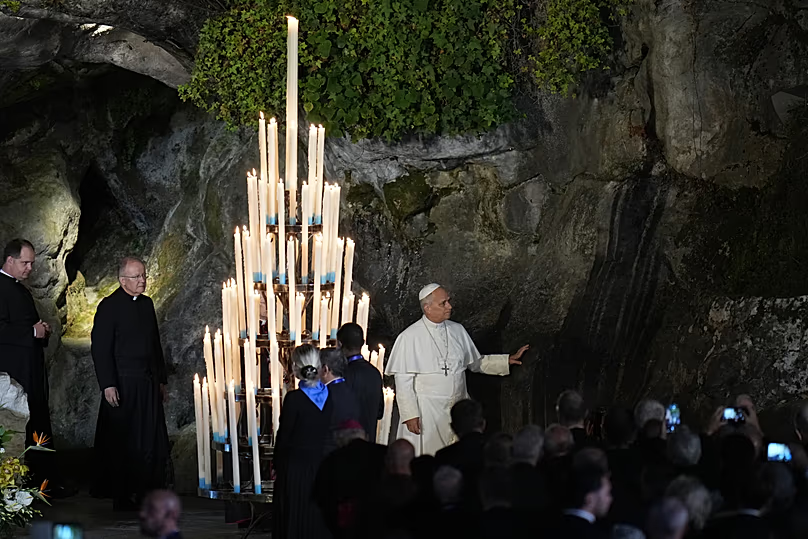
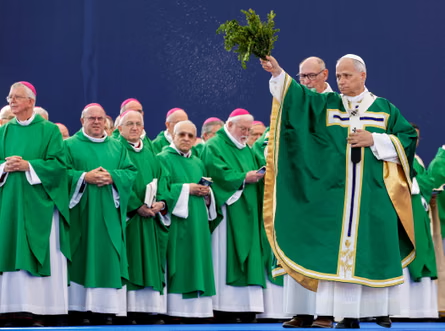
On a Sunday in late September 2026, Pope Leo XIV stood before an enormous crowd gathered in a field near the iconic Catholic shrine of Lourdes, France, and did something that senior figures in the Church have historically struggled to do with any real conviction: he told the truth about the institution he leads.
The pontiff called on the Catholic Church to heal its “deep wounds” and reckon with its “painful errors,” delivering remarks that carried unmistakable gravity given what was scheduled to follow later that day. According to reporting from The Guardian, Pope Leo XIV met with survivors of child sexual abuse as part of his four-day tour of France, a visit that has drawn intense scrutiny from advocates who have spent years pushing the Church toward genuine accountability.
Words at a Sacred Site
There is something deliberately symbolic about choosing Lourdes as the backdrop for this moment. The shrine, nestled in the foothills of the Pyrenees, is perhaps the most spiritually charged site in French Catholicism. Millions of pilgrims visit each year seeking healing. That the pope would invoke the language of wounds and errors at this specific location was not accidental. It was a statement wrapped inside a setting.
Yet the address stopped short of explicitly naming the sexual abuse scandals that have scarred the French Church for decades. The scale of that trauma is staggering: investigations have revealed that at least 330,000 children suffered abuse within Catholic institutions in France over a period of seven decades. That number, confirmed through extensive independent inquiry, sits like a stone in the chest of every survivor who has fought to be believed.
The pope’s language, while pastoral and serious in tone, left room for interpretation. Critics will note that “deep wounds” and “painful errors” are phrases that acknowledge suffering without fully centering the perpetrators who caused it or the institutional structures that protected them. Advocates have long argued that the Church’s crisis is not simply one of historical mistakes, but of active concealment and deliberate organizational failure.
Meeting the Survivors
Whatever the debate around his public address, the private meeting with abuse survivors was the most consequential moment of Pope Leo XIV’s French itinerary. These encounters, when they happen at all, carry an immense burden. Survivors who agree to meet with Church leadership often do so after years of being dismissed, disbelieved, or quietly pressured into silence. To sit across from the man at the top of the institution that failed them is an act of extraordinary courage.
The Catholic Church has held similar meetings in various countries over the past decade, with varying degrees of sincerity and follow-through. Ireland, Australia, and the United States have all been sites of major clerical abuse reckonings. France, given the documented scale of abuse outlined in damning national reports, occupies a particularly raw position in that global conversation.
What Accountability Actually Looks Like
Acknowledgment and accountability are not the same thing. Survivors and their advocates have been consistent and clear on this point for years. A pope speaking movingly about wounds before a crowd is one thing. Structural reform, transparent reporting mechanisms, removal of clergy who abused or covered up abuse, and genuine legal cooperation with civil authorities are another matter entirely.
Pope Leo XIV’s papacy is still relatively young in the long arc of institutional religion, and his approach to this crisis will define much of his legacy. The language he used in Lourdes suggests an awareness that the Church cannot simply move forward without looking back. Whether that awareness translates into concrete policy shifts remains the central question hanging over this visit.
France’s Unfinished Reckoning
France is not a passive backdrop to this story. The country has produced some of the most thorough independent reporting on clerical abuse of any nation, and French survivors’ groups have been vocal, organized, and politically active. Civil society pressure here has forced conversations that the Church would have preferred to manage quietly and internally.
The four-day papal visit arrives in this context, not as a triumphant pastoral tour but as a diplomatic and moral high-wire act. Every word the pope speaks, and every word he chooses not to speak, will be parsed by survivors, journalists, and Church reformers alike. The crowd at Lourdes came in faith. The survivors who met with the pope came, one imagines, in something closer to hard-earned hope.
There is a version of this visit that ends with renewed trust between the Church and the communities it has harmed. There is also a version where carefully chosen words provide comfort to Rome while survivors leave feeling that the institution still prioritizes its own image over their justice. Which version this turns out to be will depend far less on what was said near the shrine, and far more on what happens in the months and years that follow.
Pope Leo XIV has opened a door. The question worth asking now is: will the Catholic Church actually walk through it, or will it, as it has done before, quietly let that door swing shut once the cameras have moved on?