



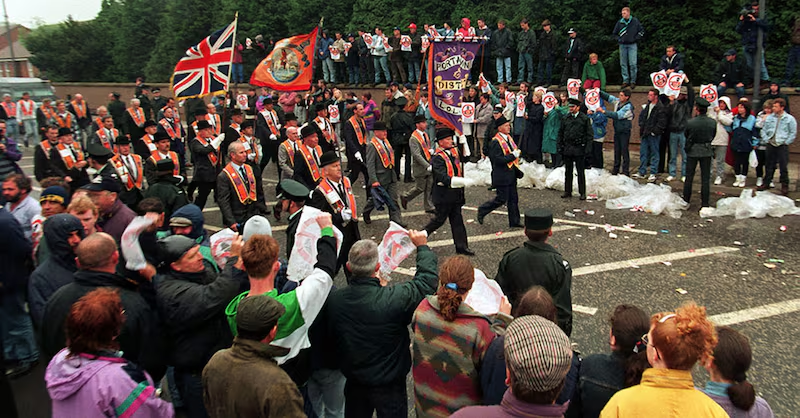
Late on a Saturday night in September 2026, a court ruling quietly rewrote nearly three decades of uneasy peace in one of Northern Ireland’s most combustible flashpoints. An appeal court dismissed the injunction that had kept the Orange Order off Garvaghy Road in Portadown since 1998, clearing the way for a march that carries the weight of generations of grievance, on both sides of the divide.
The parade, set to step off at 8am on Sunday morning, would mark the first time the Orange Order has walked that particular stretch of road in 28 years. For loyalists, it is a matter of civil and religious liberty. For the nationalist residents of Garvaghy Road, it is something else entirely.
Why Garvaghy Road Matters
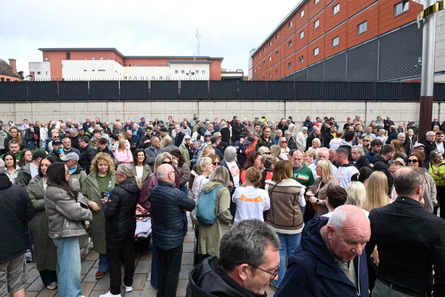
To understand the significance of this moment, you have to understand the geography and the history. Garvaghy Road runs through a predominantly nationalist area of Portadown, a town in County Armagh that has long served as a pressure point for Northern Ireland’s deeper tensions. The Orange Order, a Protestant fraternal organisation with deep roots in Ulster unionism, has historically marched this route as part of its traditional parade season.
The problem, as nationalist residents have argued for decades, is that a loyalist parade through their neighbourhood is not a neutral act of cultural expression. It is experienced as an assertion of dominance, an annual reminder of a political and social hierarchy they reject. When the injunction was put in place following the turbulent summers of the mid-to-late 1990s, many saw it as an overdue acknowledgment of that reality.
The Drumcree standoffs of the 1990s, where Orange Order marchers clashed repeatedly with police and nationalist protesters over the right to parade this very route, became synonymous with the worst excesses of sectarian conflict during the tail end of the Troubles. Four young brothers died in an arson attack in 1998, their deaths directly linked to the violence that had erupted around Drumcree. The injunction that followed was, in many ways, written in that blood.
A Legal Back-and-Forth That Few Expected to End This Way
The ruling did not arrive without drama. In the days before the appeal court’s decision, there had been a rapid legal back-and-forth that kept both communities, and security forces, on edge. The eventual dismissal of the ban came late on Saturday night, giving authorities and residents little time to prepare for what Sunday morning would bring.
Fears of fresh sectarian violence were not theoretical. Northern Ireland’s peace, while durable, has never been unconditional. Tensions around parade routes, flags, and monuments have repeatedly tested the limits of the Good Friday Agreement’s architecture. A march of this symbolic weight, through a neighbourhood that never wanted it back, carried obvious risk.
What the Orange Order Says
For the Orange Order, this ruling is a vindication. The organisation has maintained for years that its right to march traditional routes is a matter of cultural heritage and civil liberty, one that should not be subject to what it views as a veto from one community. From the loyalist perspective, the injunction was always a capitulation to intimidation, and its removal is a restoration of rights that should never have been suspended.
That argument has genuine legal and philosophical weight. Rights to peaceful assembly and freedom of expression are not trivial considerations. The question has never really been whether the Orange Order has the right to march in principle, but rather whether any right is absolute when its exercise causes demonstrable harm to others.
What Nationalist Residents Are Facing
For the people who live on and around Garvaghy Road, the ruling arrives as something between a provocation and a wound reopened. The residents’ coalition that has long opposed the march has argued consistently that the parade is not about culture or religion in any meaningful sense when it passes through their community. It is about power. The 28-year ban was not just a legal technicality for them. It was a signal that their concerns had weight.
That signal has now been reversed. Whatever security measures are deployed on Sunday morning, the symbolic message of the ruling will linger long after the last drum has faded.
Northern Ireland’s Fragile Peace Under the Spotlight
It would be too simple to frame this as a victory for one side and a defeat for another, though both communities will likely frame it in exactly those terms. The more uncomfortable truth is that Northern Ireland’s political settlement has always depended on a kind of managed ambiguity, on contested issues being neither fully resolved nor fully reignited. The Garvaghy Road injunction was one of those managed ambiguities.
Its removal does not mean the conflict is resolved. If anything, it reopens questions that the peace process has spent nearly three decades carefully sidestepping. Can a society built on two deeply different understandings of identity and sovereignty genuinely share the same streets? And if it can, who gets to decide the terms?
Security forces in Northern Ireland will be watching Sunday’s march with considerable anxiety. So will politicians in Belfast, Dublin, and London. A peaceful parade would represent a kind of maturity, proof that the region can hold difficult moments without returning to violence. Disorder would feed narratives on all sides that are better left unfed.
The Morning the Drums Return
At 8am on a Sunday in late September 2026, the Orange Order will walk a road it has not walked in 28 years. Whatever happens next will be written into the long, complicated history of a place that has never quite managed to be ordinary.
The ruling is legal. The march is permitted. But permission and wisdom are not always the same thing, and in Portadown, the gap between the two has historically been measured in violence, grief, and years of uneasy quiet.
Whether this moment becomes a turning point toward genuine shared society, or another entry in a very long ledger of wounds, depends on what happens not just on Sunday morning but in the days and weeks that follow. History in Northern Ireland tends to move slowly and then, suddenly, all at once.
As the news settles and the world watches, it is worth asking: can a community’s right to march ever truly be separated from the impact that march has on the people it passes through, and if not, who should have the final say?