

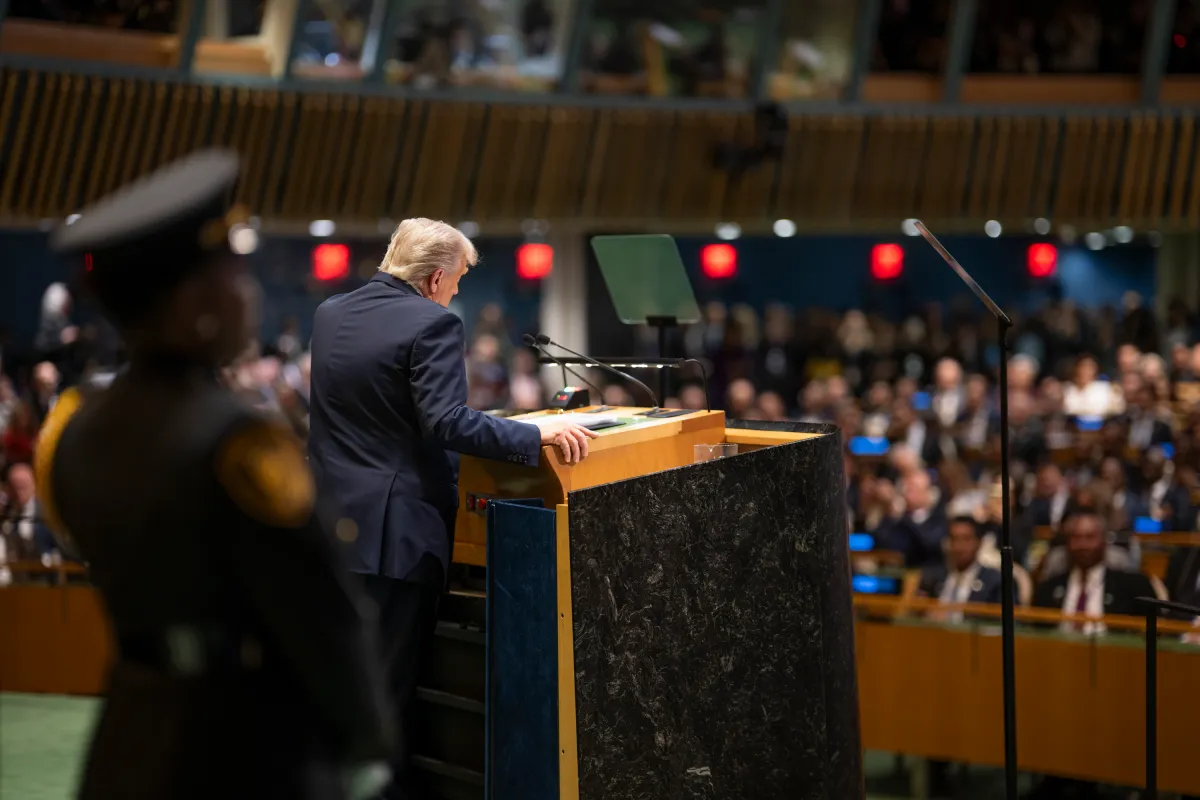
On Tuesday, September 23, 2026, Donald Trump stood at the podium of the United Nations General Assembly in New York and delivered the kind of line that stops a room cold. He threatened to “annihilate” Iran, words that carry an unmistakable weight when spoken by a sitting American president in front of a global audience. But the real drama was not inside the hall. It was playing out in the corridor just outside the building, and in the approval data bleeding out of Washington.
Muscle-Flexing on the World Stage
There is something almost scripted about an American president turning to the United Nations as a place to project strength. For Trump, the calculation is straightforward: the UN stage offers a global megaphone, an audience of world leaders, and the visual gravitas of a podium that carries the seal of the most powerful office on earth. His threat toward Iran was not an off-the-cuff remark. It was the centrepiece of a performance designed to signal that the United States, under his watch, still operates from a position of supreme confidence.
The problem, as even casual observers of American politics have noticed, is that projecting confidence abroad does not automatically translate into credibility at home. And right now, Trump’s credibility at home is under serious pressure.
The Polls, the Party, and the Growing Fractures
Trump’s approval ratings have been sliding, and what makes this moment politically significant is not just the numbers themselves. It is the fact that some Republicans are starting to drift from the party line. When a president loses members of his own base, the usual strategy of rallying the faithful no longer functions as a clean escape hatch. The party unity that carried Trump through two terms and multiple storms is showing real cracks.
This is the context in which analysts are reading Trump’s behaviour at the UN differently to how they might have read it a year ago. An 80-year-old president who controls the bully pulpit of the world’s leading military power is not someone to dismiss lightly. But a leader whose domestic standing is eroding is also a leader with something to prove, and leaders with something to prove tend to reach for bigger levers.
The phrasing used by some political observers captures it well: the weaker the political position, the sharper the rhetorical edges. Threats and aggressive posturing become substitutes for the kind of legislative momentum or public goodwill that would normally anchor a presidency in its final stretch.
The CNN Moment Nobody Planned For
Before Trump even entered the UN building, the day produced one of those unscripted collisions that end up defining a news cycle. Kaitlan Collins, an anchor at CNN, approached the president with questions. This would be unremarkable in any normal political environment. But Trump had previously banned CNN from the White House, a move that was later struck down by a federal judge.
The president’s reaction to seeing her there was sharp and immediate. “I’m surprised that CNN is here covering me,” he said. “You should not be here covering me.” At 80 years old, facing a global press corps and a full schedule of diplomatic events, Trump took a moment to relitigate a media feud that a court had already settled against him.
It was a small exchange in the grand sweep of a UN week, but it spoke volumes. A man entirely comfortable in his own power does not need to remind a reporter that she shouldn’t be there. That instinct to lash out at the press, at critics, at anyone who represents a challenge, looks different when the political winds are not at your back.
What This Pattern Tells Us
American presidents have always used international forums to reset narratives that are going badly domestically. The temptation is almost structural: when Congress is awkward, when courts rule against you, when your own party is restless, the world stage offers a kind of relief. You are commander in chief of the most formidable military on the planet. You can say things there that command attention regardless of what your approval numbers look like back in Ohio or Arizona.
But the relief is temporary. The cameras follow you home. The polling data does not pause for diplomacy. And the reporters, regardless of what a president prefers, keep showing up.
Trump’s UN appearance this week was, in many ways, a mirror held up to a presidency navigating a difficult passage. The boldness of the Iran threat, the irritation at CNN’s presence, the performance of dominance on a stage where dominance is expected: these are the moves of a politician who knows the ground has shifted and is refusing to yield to it.
What Comes Next
The immediate diplomatic fallout from the Iran threat will play out over weeks, not days. World leaders will parse the language, intelligence services will assess intent, and America’s allies in the region will calculate their own positions accordingly. Words spoken from the UN podium carry legal and diplomatic weight, and “annihilate” is not a word any diplomatic corps takes lightly.
Back home, the more pressing question is what a president with slipping approval ratings and a restless party does next. History offers a fairly consistent answer: it usually involves getting louder, moving faster, and leaving less room for nuance. That can look like leadership. It can also look like panic. The difference, more often than not, depends entirely on whether the results follow.
For now, Trump has done what Trump tends to do. He found the biggest room available, said the most dramatic thing possible, and dared the world to look away. The world, as always, did not. Whether that attention serves him or exposes him is the question that will define the months ahead. What do you think: does aggressive global posturing help a president recover domestic ground, or does it simply accelerate the reckoning?