


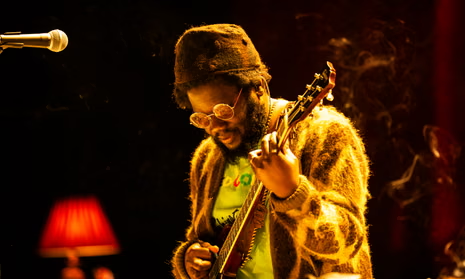
Michael Kiwanuka, the British-Ugandan singer-songwriter widely regarded as one of the most soulful voices of his generation, has disclosed that he suffered a stroke several months ago and is currently working through what he describes as a long rehabilitation process. The 39-year-old made the announcement on Instagram, pairing difficult personal news with the reveal of his fifth studio album, Fudge, in a post that stopped fans mid-scroll.
A Brain Bleed Behind the Silence
The musician, born in London to Ugandan parents, explained that the stroke was caused by a bleed in his brain connected to high blood pressure. He did not soften the severity. Kiwanuka described the brain injury as serious and acknowledged that the path to recovery will be a lengthy one. For followers who had noticed his absence from scheduled performances in the United States, this was the explanation they had been waiting for, though perhaps not the one anyone had anticipated.
High blood pressure, often labelled the silent killer precisely because it rarely announces itself with dramatic symptoms, can cause haemorrhagic strokes when the pressure inside blood vessels becomes too great and a vessel ruptures. For a touring musician living the relentless cycle of recording, travelling, and performing, the physiological toll of that lifestyle is easy to underestimate from the outside. Kiwanuka’s openness cuts straight through that illusion.
What He Said and Why It Matters
According to reporting on Kiwanuka’s announcement, the artist was candid about the uncertainty surrounding his return to the stage. He said his recovery will determine what his future looks like in terms of touring and performing. That kind of honesty, from an artist at the peak of his creative powers, is striking. No vague references to needing rest. No carefully managed PR statement. Just a clear, human acknowledgment that he does not know when, or fully how, life returns to normal.
It also reframes the missed US shows that had gone largely unexplained. Fans who were left disappointed by cancellations now have context, and that context demands empathy rather than frustration.
The Album That Arrives Amid All of This
That Kiwanuka chose to announce Fudge, his fifth studio album, in the same breath as his health news is telling. It speaks to an artist who refuses to be swallowed whole by circumstance. His discography has always carried weight: from his Mercury Prize-winning self-titled album in 2020 to the warmly received Love & Hate before it, Kiwanuka has built a reputation for music that sits with you, that does not rush toward resolution.
The timing of a new album announcement, given that he cannot yet confirm when he will tour in support of it, raises genuinely interesting questions about how artists navigate illness and output in an era when the live circuit is often the primary revenue engine. Streaming pays a fraction of what a sold-out arena does. For Kiwanuka, whose artistry has always transcended mere commercial calculation, the music itself may be part of the healing.
Stroke in Younger Adults: A Growing Conversation
Kiwanuka’s disclosure also lands at a moment when medical communities across the world are paying greater attention to strokes in younger adults. Historically framed as a condition that primarily affects people over 65, strokes are increasingly being diagnosed in people in their 30s and 40s. Risk factors including hypertension, stress, poor sleep, and sedentary lifestyle are far more prevalent in this age group than many realise.
The rehabilitation process following a stroke can involve speech therapy, physiotherapy, occupational therapy, and significant psychological support. Recovery timelines vary enormously depending on which part of the brain was affected and the extent of the bleed. For someone like Kiwanuka, whose craft depends on fine motor skills, breath control, vocal precision, and emotional access, the stakes of that recovery are acute.
A Career Worth Rooting For
Kiwanuka has never been the loudest presence in a room, musically or personally. His work tends toward introspection: layered arrangements, lyrics that circle vulnerability without being defeated by it, and a voice that carries grief and grace in equal measure. That disposition, it turns out, extends to how he handles crisis. He shared his news not as a bid for sympathy but as an act of transparency with the people who have followed his journey.
Born in north London to parents who emigrated from Uganda, Kiwanuka has spoken in past interviews about the challenges of carving out space in an industry that did not always know how to categorise him. He found his footing by trusting his instincts, and that trust produced some of the most emotionally resonant albums of the last decade. A health setback of this magnitude, as brutal as it is, has not dimmed his creative voice. The announcement of Fudge is proof of that.
The music world has rallied behind artists navigating serious illness before, and there is every reason to believe fans will show up for Kiwanuka now, both for the album and the recovery. The road ahead is uncertain and, by his own account, long. But Michael Kiwanuka has always written best about journeys that do not offer easy endings.
What does it say about our expectations of artists that we are surprised when they step back to take care of themselves, and how can we, as listeners, better support the humans behind the music we love?