











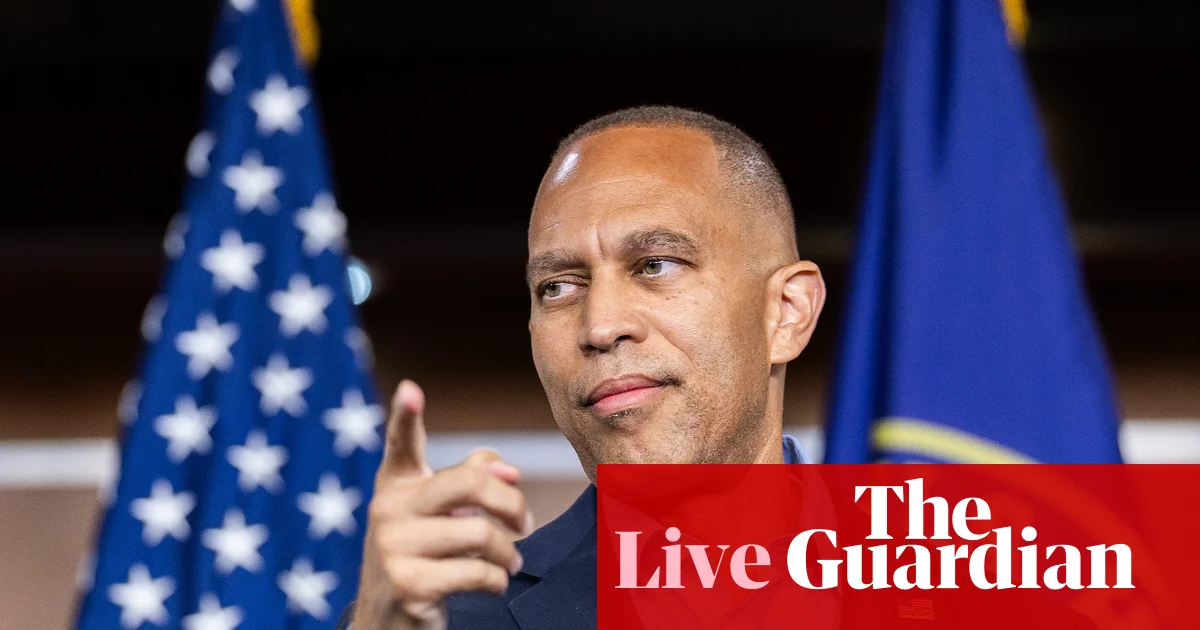
House minority leader Hakeem Jeffries delivered a sharp rebuke on September 2, 2026, after two House Democrats crossed party lines to help Republicans advance a resolution formally condemning socialism. Jeffries, speaking with the kind of deliberate firmness that signals genuine institutional anger rather than performative outrage, described the move as a “significant breach of trust” and made clear that a “serious response” was forthcoming. In a week already churning with geopolitical turbulence, the internal Democratic fracture landed like a stone in already choppy water.
A Vote That Broke Ranks
The resolution in question was straightforward in its political intent: a symbolic but pointed congressional statement condemning socialism, the kind of measure Republicans reliably use to put Democrats on the record and create campaign-season ammunition. In most circumstances, the minority party closes ranks on exactly these kinds of votes. Symbolic resolutions are the political equivalent of a trap set in the middle of a well-lit room. Stepping into one requires either genuine conviction or a serious miscalculation of the consequences.

For two House Democrats, the calculation apparently seemed worth it. Their identities and specific constituencies were not detailed in the available reporting, but their choice reverberated almost immediately through the party leadership. Jeffries, who has worked carefully to project unity and strategic discipline since taking over as minority leader, was direct about what the defection meant. This was not a minor procedural quibble or a good-faith policy disagreement. It was, in his framing, a breach, a word that carries weight and implies that repair work lies ahead.
Why Party Discipline Matters Right Now
Context matters here. Congressional Democrats are operating in a difficult environment, where every vote, every procedural motion, and every public statement feeds into a broader narrative about whether the party can function as a coherent opposition. Jeffries has staked significant credibility on demonstrating that it can. A defection on a vote as symbolically loaded as an anti-socialism resolution does not just create a news cycle headache. It hands opponents a ready-made storyline about cracks in the caucus.
The timing compounds the problem. US political news is moving at a punishing pace, with American military forces resuming strikes on Iran drawing intense scrutiny and consuming significant attention across media and government. When the foreign policy landscape is this volatile, the last thing a minority leader needs is a domestic story about his own members undermining party strategy.
Trump Weighs In on His Own Priorities
President Donald Trump, for his part, appeared to be keeping his attention focused on a rather different set of concerns. On Wednesday morning, he posted to Truth Social about what he described as a ballroom and military complex under construction in Washington D.C., painting a picture of hundreds of workers busily building what he called “the finest Ballroom/Military complex anywhere in the World.” He framed the project as a hard-fought legal victory, writing that despite a long battle in the courts, the winner was, as he put it, “as always under ‘TRUMP,’ the U.S.A.”
The juxtaposition is hard to ignore. American military assets are conducting strikes on Iranian targets, Democratic Party unity is fracturing on the House floor, and the president is posting about a ballroom. It is a snapshot of an American political moment that resists easy summary.
What Comes Next for Jeffries
The minority leader’s promise of a “serious response” leaves the specific consequences deliberately vague, which is itself a strategic choice. Announcing punitive measures too quickly can look reactionary. Waiting allows the implicit threat to do its work, signaling to every other member of the caucus that loyalty has a real and enforced value.
Jeffries has built his leadership identity around the idea that Democrats can be disciplined without being rigid, united without being monolithic. That is a genuinely difficult balance to maintain, and votes like this one test it. The two members who crossed the aisle may have believed their individual political situations warranted the decision. But in a body where every number counts and every symbolic vote feeds the larger partisan battle, individual calculations carry collective costs.
The Broader Picture
What this moment really reveals is the ongoing tension at the heart of a congressional minority trying to define itself in opposition to a dominant political force. Democrats are not simply voting against specific policies. They are constantly constructing an argument about who they are and what they stand for. A vote to advance an anti-socialism resolution, however symbolic, complicates that construction.
Whether the “serious response” Jeffries has promised amounts to formal censure within the caucus, loss of committee assignments, or something more subtle, it will send a message. In politics, the messages sent internally often matter more than the ones sent to the public. The rank and file will be watching carefully to see how firmly the leadership is willing to draw the line it has just announced.
As the United States navigates a genuinely complex international situation and an increasingly volatile domestic political climate, the question worth sitting with is this: can any minority party sustain the kind of iron-fisted unity needed to be an effective opposition, or does the pressure of individual political survival always eventually pull members in different directions?