










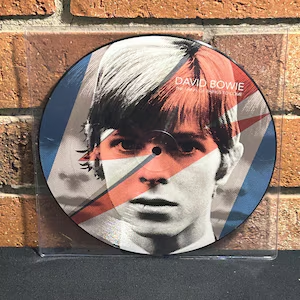
He reinvented himself so many times that one more transformation barely registers as a surprise. But arriving at Venice Film Festival as a three-dimensional extended reality experience, surrounded by virtual wolves, digital wildfires, and the birth of stars, is still quite the entrance, even by David Bowie’s standards.
This September, the 10th anniversary edition of Venice Immersive opened its doors on Lazzaretto Vecchio, a repurposed island off the Venice Lido, with Bowie front and centre in one of its most talked-about entries. “David Bowie: Unseen Unheard” is a 3D documentary built around hundreds of photographs that have never been publicly shown before. For devoted fans and casual admirers alike, the prospect is nothing short of electric.
What Is Venice Immersive, and Why Does It Matter?
Venice Immersive sits within the wider Venice Film Festival ecosystem, but it occupies its own universe entirely. Since its launch a decade ago, the programme has served as a meeting point between emerging technology and traditional cinematic storytelling. Think of it less as a tech expo and more as a creative laboratory, one where filmmakers, artists, and developers are given permission to rethink what a “film” can even be.
Now in its 10th year, the showcase carries 69 XR pieces, a figure that reflects just how rapidly the extended reality space has grown. XR, which stands for extended reality, covers the full spectrum of immersive technologies: virtual reality, augmented reality, and mixed reality experiences. These are not passive screenings. They are worlds you enter, environments that react, and stories that surround you from every angle.
The Lazzaretto Vecchio island setting adds its own layer of magic. Once a quarantine station for travellers arriving in Venice centuries ago, it now functions as a kind of portal between realities, which feels almost too perfect for an event dedicated to blurring the boundaries of perception.
Bowie Unseen: A Treasure Chest Opens
The Bowie documentary is the kind of project that makes you wonder why it took this long. Hundreds of photographs that never made it into albums, press kits, or retrospective books are finally seeing light. In 3D format, they are not simply displayed, they become spatial, intimate, almost tactile. There is a difference between looking at a photograph of Bowie and feeling like you are standing in the room where it was taken. This experience attempts the latter.
Those close to the project have described Bowie as someone who was always willing to push boundaries. That quality makes him a natural fit for a format that refuses to sit still. His career was littered with moments where he saw a direction nobody else had spotted yet, whether in music, fashion, or visual art. Casting him as the subject of an XR documentary feels less like a novelty and more like a logical continuation of who he was.
The images themselves are the real draw. Archival material carries a particular weight when it genuinely has not been seen before. There is no recycled press shot fatigue here, no “oh, that one again” moment. Each photograph is a genuine discovery, and the 3D presentation gives that sense of discovery a physical dimension.
The Wider Programme: Wolves, Wildfires, and Newborn Stars
Bowie shares the Venice Immersive bill with a fascinatingly eclectic lineup. Virtual worlds built around wildfires place audiences inside one of the defining environmental crises of the modern era, offering an experiential empathy that no news broadcast can replicate. Wolves feature in their own immersive context, bringing the natural world into vivid digital focus. And then there are experiences that look upward, into the cosmos, tracing the violent beauty of stellar formation.
The breadth of the programme is deliberate. Venice Immersive has never wanted to be a showcase purely for technology enthusiasts or film purists. It aims to plant itself at the intersection of both worlds, drawing audiences who might not otherwise consider wearing a headset alongside those who have been building in XR for years.
What ties these wildly different subjects together is the format itself. Extended reality is uniquely suited to subject matter that demands scale, whether that is the scale of a rock legend’s archive, the scale of a burning landscape, or the incomprehensible scale of the universe.
Ten Years of Immersive Storytelling: A Look Back
A decade is a meaningful stretch of time in any creative field, but in the XR space it represents multiple lifetimes. When Venice Immersive launched, consumer virtual reality headsets were clunky novelties and the idea of mainstream XR content felt optimistic at best. The tools, the hardware, and the creative language have all evolved dramatically.
Early editions of the programme often featured work that was technically impressive but narratively thin. The storytelling caught up with the technology gradually, as creators moved past the initial “look what this can do” phase and began asking deeper questions about what these formats could say, and how they could say it.
By this 10th anniversary, the organisers are clearly proud of how far the medium has come, while being careful not to declare any kind of arrival. The work of bridging emergent technology and traditional cinema narrative is ongoing, and if anything, the more sophisticated the tools become, the more responsibility falls on creators to use them with genuine purpose.
Why Bowie and XR Are a Natural Match
There is something philosophically fitting about Bowie’s presence at this event. His entire career was an argument for the power of reinvention, for the idea that identity is fluid and performance is always in progress. Extended reality makes a similar argument about storytelling: that it does not have to sit in a fixed frame, play out on a flat screen, or follow a single linear path.
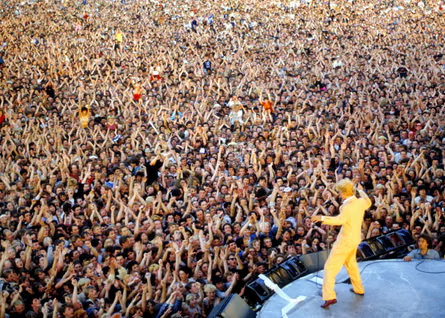
Both Bowie and XR understand that the audience is not a passive receiver. His live performances demanded engagement, transformation, a willingness to be changed by what you witnessed. XR experiences ask the same thing, placing the viewer inside the story rather than outside it.
Whether “David Bowie: Unseen Unheard” fully delivers on that philosophical promise is something audiences at Venice are now in a position to judge for themselves. But the concept alone is enough to make even the most sceptical observer curious.
The conversation around how we remember cultural icons is shifting. Static museums, coffee table books, and linear documentaries have served their purpose. But as the tools grow more immersive, the question becomes harder to ignore: if you could spend time inside the world of a legend rather than simply reading about it, would you choose anything else?