








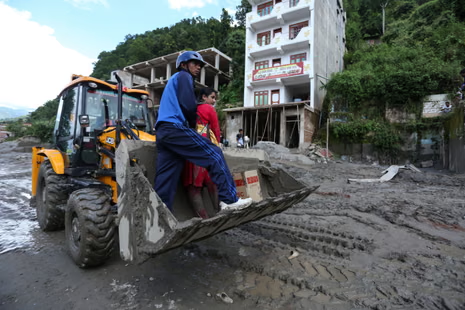
Forty-three Australian citizens remain unaccounted for on September 1, 2026, following severe flooding that has torn through Nepal and parts of Tibet, with Australian Foreign Affairs Minister Penny Wong delivering a stark and sombre warning that the government’s anxiety over their fate intensifies with every hour that passes without contact.
The crisis has gripped Australia in a way that few international disasters have in recent memory. These are not abstractions or statistics. They are tourists, trekkers, volunteers, and adventurers, real people with families refreshing their phones at kitchen tables across the country, waiting for a call that has not come.
A Minister’s Candid Fear
Wong has not reached for diplomatic language to cushion the blow. Speaking publicly about the situation, she acknowledged that the absence of news is not neutral, that silence, in a disaster zone, tends to carry its own weight. “Every day, every hour, only increases our concern for those who have not been found,” she said, according to live updates from The Guardian. She described the situation plainly as “distressing,” and extended her thoughts to the families and friends enduring what she called a traumatic experience.
That kind of language from a senior minister is deliberate. It signals that the Australian government is not preparing the public for good news. It is preparing them, gently, for something harder.
The Scale of the Disaster
Nepal and the Tibet region have long drawn Australians in large numbers, whether for Himalayan trekking, cultural immersion, or humanitarian work. The terrain that makes those experiences extraordinary is also what makes disasters there so difficult to respond to. Roads wash out. Communications collapse. Helicopters cannot always fly.
When flooding hits at altitude, the physics are brutal. Water moves faster, carries more debris, and cuts off escape routes with terrifying speed. Communities that rely on single mountain roads can be isolated for days or weeks. Search and rescue teams, no matter how experienced, face conditions that slow everything down.
That physical reality is exactly what makes Wong’s comment about time so loaded. Each passing hour without a rescue or a confirmed location is an hour in which conditions can deteriorate further.
One Survivor Found in Tibet
There is at least one piece of news that offers a sliver of hope amid the broader concern. One Australian who had been listed as missing was found alive in Tibet, a development that serves as proof that survival is possible even in the most challenging circumstances. It is the kind of story that rescuers hold onto as fuel when the work becomes overwhelming. It is also the story that families of the other 43 are holding onto right now.
What the Australian Government Is Doing
The Australian government has confirmed it is actively engaged in consular efforts, working with local authorities and international partners to locate and assist its citizens. The Department of Foreign Affairs and Trade has been a central coordination point, and Australian officials are understood to be on the ground or in close communication with teams in the region.
Consular responses to mass casualty or missing persons events in remote regions are always complicated by geography and by the limits of what diplomatic staff can physically do versus what search and rescue teams on the ground control. Australia has experience navigating these situations, but experience does not make them easier or faster.
Families in Limbo
The human dimension of this crisis is impossible to overstate. Forty-three sets of families, which in practice means hundreds of people, parents, partners, siblings, children, are living in a kind of suspended dread. They know something has gone wrong. They do not yet know how wrong.
Wong’s public acknowledgment of that trauma matters because it signals that the government sees these people, not just as a consular caseload but as Australians whose suffering is real and recognised. Whether that translates into the outcome families are desperately hoping for remains, as of September 1, 2026, deeply uncertain.
A Broader Moment of National Anxiety
Australia’s relationship with the Himalayan region is a long and personal one. Thousands of Australians visit Nepal alone every year, drawn by the mountains, the culture, and the sense that there are still corners of the world that feel genuinely remote and alive. When disaster strikes in those places, it lands differently than a news story about a far-off country with no connection to daily Australian life.
This is a story about someone’s daughter who went trekking. Someone’s husband who volunteered with a local NGO. Someone’s university friend who posted a photo from Kathmandu three weeks ago and has not been heard from since. That intimacy is what makes the 43 figure feel so heavy.
The coming hours and days will be decisive. Rescue windows in flood-affected mountain regions are not indefinite, and the longer the search extends, the more the nature of what teams are looking for begins to shift. Australia is watching, hoping, and waiting for news that can only be delivered from the mountains themselves.
As the search continues and families hold their breath, one question lingers for all of us: what more can governments and international rescue networks do to protect travellers in some of the world’s most remote and beautiful, but dangerously vulnerable, places?