








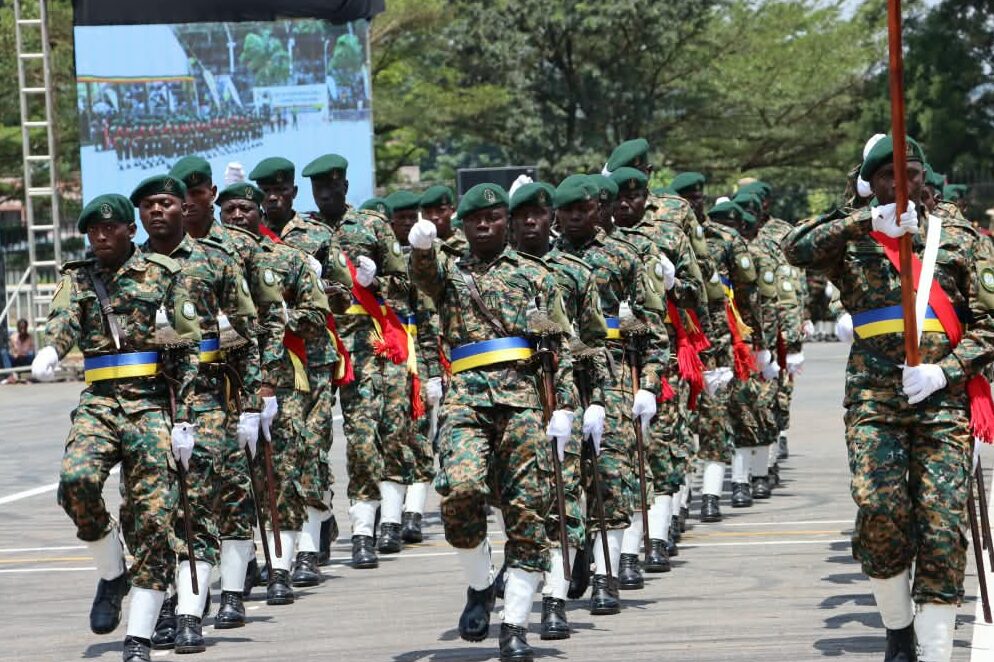
On a Wednesday morning at Kololo Independence Grounds in Kampala, Uganda’s Minister of Defence Kiryowa Kiwanuka stood before ranks of soldiers and delivered a message that was equal parts rallying cry and institutional challenge. The occasion was the second edition of the Chief of Defence Forces Interforces Drill Competition 2026, a gathering that brought teams from across the Uganda Peoples Defence Forces together in a contest of precision marching. But the minister made clear that what was on display went far beyond polished boots and synchronised steps.
A Competition With Stakes Beyond the Trophy
Drill competitions in military settings carry a reputation for ceremony and tradition, and they are easy to dismiss as elaborate performance. Kiryowa Kiwanuka walked directly into that assumption and dismantled it. According to a report on the event, the minister told assembled forces plainly: “An army that cannot drill cannot fight.”
That single sentence reframes the entire exercise. It is not a cultural tradition kept alive out of nostalgia for military pageantry. It is, in the minister’s reading, a direct indicator of operational readiness. The argument is straightforward and carries real weight in military theory: the same mental wiring that produces precise formation movement under the eyes of judges produces precise coordinated action under fire. Remove one, and you weaken the other.
Kiryowa went further, describing what the competition actually measures. “What we celebrate today is not simply a drilling exercise; we celebrate the growth and excellence of the UPDF,” he told the gathering. For a defence minister to frame a marching competition as an institutional growth metric signals something about how leadership views the UPDF’s internal culture and where they believe its standards need to be anchored.
Discipline as Architecture, Not Ornament
The most substantive part of the minister’s address was his articulation of what drill actually builds inside a soldier. He was careful to separate the activity from its surface appearance. “Drill is not just marching, drill is the foundation of military discipline,” Kiryowa said. “It is where obedience, teamwork, alertness, and pride in service are built.”
This is a position with deep roots in military doctrine across multiple armed forces globally. The logic holds that structured repetition under command conditions rewires behaviour. A soldier who has spent hundreds of hours learning to respond instantly to an order, to move as part of a unit rather than as an individual, and to maintain form under physical and psychological pressure does not simply look better on a parade square. That soldier carries those habits into every operational environment they enter.
The minister spelled out the exact qualities drill instils: the ability to listen intently, to obey instantly and correctly, to work as a collective body, and to maintain endurance and composure under pressure. Each of those qualities maps directly onto combat effectiveness. None of them are trivial. All of them are teachable, and drill, in the UPDF’s institutional framework, is one of the primary classrooms.
Lt Gen Okiding and the Question of Reputation
Deputy Chief of Defence Forces Lieutenant General Sam Okiding added a dimension to the conversation that shifted the focus from training philosophy to regional standing. In his remarks at the competition, he described discipline as the quality that separates an army that genuinely functions from one that merely looks organised from a distance.
“Discipline sharpens the attention to detail and strengthens coordination, cooperation, and teamwork,” Okiding said. “It develops confidence, unity, and ability to respond promptly and effectively and ensures operational effectiveness of any modern force.”
His most pointed observation came when he connected the UPDF’s discipline culture directly to its reputation among regional peers. “That is why we at UPDF are respected because we have tried to embed this in our blood,” he said. That is not an idle boast. The UPDF has been deployed in a range of complex regional security environments, and its conduct in those missions feeds directly into how Uganda is perceived as a military partner on the continent. Discipline is not simply an internal virtue. It is a foreign policy asset.
Widening the Net: A Call to Commanders
Okiding also used the occasion to push the competition’s reach further into the force’s structure. His call was directed specifically at commanders and leaders at all levels, urging them to ensure that officers and personnel under their command get the opportunity to participate in future editions of the CDF Interforces Drill Competition. The framing was not optional or aspirational. It was a directive dressed in collegial language.
The deputy CDF’s message was that drill participation should not be the preserve of a select few units that happen to be stationed close to competition venues or that have commanding officers who prioritise the exercise. It should be embedded across the entire force, reflecting the same universality that the UPDF expects of its training curriculum more broadly. “Drill is an integral part of our military training because discipline, teamwork, and attention to detail are indispensable in the military operations,” Okiding said.
What This Moment Says About UPDF’s Direction
Reading the 2026 CDF Interforces Drill Competition as a purely ceremonial event would be a mistake. The language used by both the minister and the deputy CDF was deliberate and consistent in drawing lines between visible performance and invisible readiness. Uganda’s defence establishment appears to be making a calculated argument to its own ranks: the habits built in mundane, repeated training scenarios are the same habits that will determine outcomes in the most consequential moments a soldier faces.
There is also something worth noting about the public nature of this messaging. Holding this event at Kololo Independence Grounds, a space with significant national symbolism, and having senior civilian and military leadership make these arguments publicly signals that the UPDF is not simply talking to its soldiers. It is talking to the Ugandan public, to regional observers, and to prospective partners about the kind of force it intends to be.
Military excellence is rarely born in the heat of conflict. It is built slowly, in repetition, under instruction, in conditions that do not feel urgent but create the reflexes that perform when urgency is absolute. Uganda’s defence leadership appears to understand that clearly. The question now is whether the commanders at every level of the UPDF will carry that understanding all the way down to the soldiers who will one day need it most. Do you think public drill competitions are an effective way for a military to signal and reinforce internal discipline standards, or does real readiness remain invisible until the moment it is tested?