











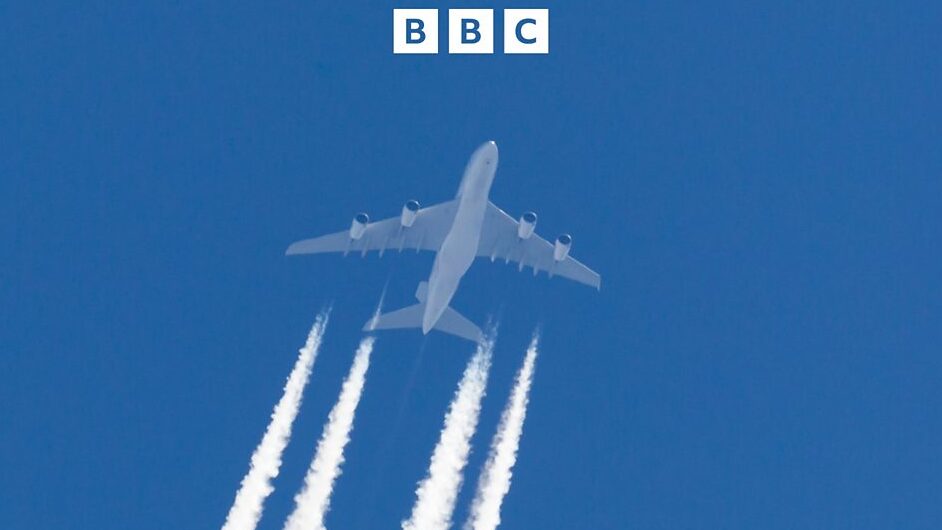
Look up on any busy travel day and you will see them: long white lines drawn across the sky by commercial jets, dissolving slowly into feathery wisps before fading altogether. They look harmless enough, almost decorative against a crisp blue backdrop. But those vapour trails, more formally known as contrails, are doing something far less picturesque behind the scenes. They are contributing to the warming of Earth’s atmosphere, and the aviation industry is only beginning to grapple seriously with the implications.
What Exactly Are Vapour Trails?
When a jet engine burns fuel at high altitude, it releases hot, water-rich exhaust into the cold, thin air of the upper atmosphere. The water vapour condenses almost immediately around tiny soot and dust particles in the exhaust, forming ice crystals. Those crystals group together into the visible white streaks we see from the ground. Under the right atmospheric conditions, cold temperatures, high humidity, those streaks persist for hours and spread into wide, diffuse cloud layers that can cover vast stretches of sky.
The trouble is that these artificial clouds behave a lot like natural cirrus clouds. During the day, they reflect some incoming sunlight back into space, which sounds useful. But their dominant effect is trapping outgoing heat from the Earth’s surface, acting like a thermal blanket. At night, with no sunlight to reflect, their warming effect is unchallenged. The net result, according to atmospheric researchers, is a warming influence on the planet. The science behind contrail warming has been gaining attention in climate circles, and it deserves a much wider audience.
A Problem Hiding in Plain Sight
For decades, the climate conversation around aviation focused almost exclusively on carbon dioxide emissions. And for good reason, CO2 is a long-lived greenhouse gas that accumulates in the atmosphere and drives warming over centuries. But contrails operate on a very different timescale. They form and dissipate within hours, yet their collective warming effect at any given moment may rival or even exceed the long-term impact of aviation’s CO2 output, depending on conditions.
This is not a fringe theory. Research published by institutions including the European Union Aviation Safety Agency and various university atmospheric science departments has repeatedly flagged contrail warming as a significant and underappreciated factor in aviation’s overall climate footprint. The catch is that unlike CO2, which accumulates predictably, contrail impact varies wildly depending on where a flight takes place, at what altitude, and what the atmospheric humidity happens to be at that moment.
Why Altitude and Route Matter More Than You Think
Here is where it gets genuinely interesting. Not all flights contribute equally to contrail warming. A jet flying through air that is already saturated with moisture will produce a long-lasting contrail that spreads across the sky. A jet flying through drier air at a slightly different altitude might produce barely a trace. This variability means that small changes in routing or altitude could, in theory, dramatically reduce the warming impact of any given flight without burning a drop less fuel.
Some aviation researchers and tech firms are now exploring real-time atmospheric data tools that could allow airlines to reroute flights away from contrail-forming conditions. The idea is elegant: use weather forecasting models to identify which parts of the sky are most likely to produce persistent contrails, then steer aircraft around or below those zones. Early trials have shown measurable reductions in contrail formation with surprisingly modest increases in fuel consumption and flight time.
The Aviation Industry’s Quiet Reckoning
Airlines and aircraft manufacturers have spent years chasing fuel efficiency and publicising their net-zero pledges. Sustainable aviation fuels, hydrogen propulsion, electric aircraft for short-haul routes, these are the headliners. Contrails, by contrast, have received far less boardroom attention, partly because the science was considered uncertain and partly because fixing the problem requires operational changes rather than headline-grabbing technology investments.
That attitude is shifting, if slowly. A handful of airlines, particularly in Europe, have been involved in contrail avoidance trials, and regulators are starting to ask harder questions about whether contrail impact should be factored into carbon reporting frameworks. If it were, the industry’s climate numbers would look considerably different.
What Passengers Can Actually Do
The honest answer is: not a great deal on an individual flight basis. You cannot choose your aircraft’s altitude or route. What passengers can do is support airlines that are actively investing in contrail research and avoidance programmes, ask questions when booking about sustainability commitments beyond CO2 offsetting, and push back against the narrative that sustainable aviation is a single-issue problem solvable only through fuel choice.
Frequent flyers, corporate travel managers, and travel journalists all have a role to play in making contrail warming part of the mainstream conversation. Every lever matters when the atmosphere is the stakes.
A Sky Full of Questions
The story of contrails is, in many ways, a story about the complexity of climate science and the dangers of focusing on one variable while ignoring others. Carbon emissions are critical. So is methane. So, it turns out, are the ice crystals trailing behind a transatlantic flight at 35,000 feet.
Aviation is one of the fastest-growing contributors to global emissions, and with air travel demand continuing to climb across Africa, Asia, and South America, the contrail problem will only grow larger unless the industry acts with genuine urgency. The technology to identify high-risk atmospheric zones already exists. The will to use it consistently, industry-wide, is what remains to be tested.
Next time you spot those white lines dissolving above your head, consider what they represent: not just a flight path, but a choice. And one of the most important questions facing aviation today is whether the industry will make better ones before the atmosphere demands it.
What do you think? Should airlines be required to report and reduce their contrail impact alongside carbon emissions, or does the complexity of the science make regulation too difficult? Drop your thoughts below and share this with anyone who has ever looked up and wondered about those lines in the sky.