







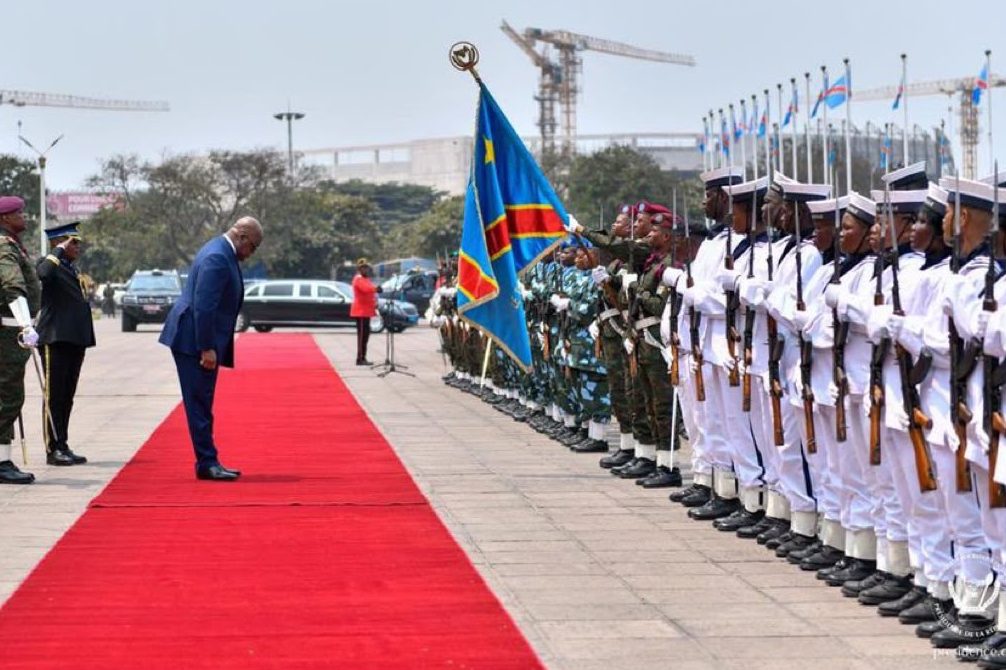
Standing before a gathering of civilian and military officials at the People’s Palace in Kinshasa on Thursday, Democratic Republic of Congo President Félix Tshisekedi announced a sweeping new national defence doctrine, one built on the conviction that true security begins not with foreign allies or borrowed strategies, but with a country’s ability to think and act for itself. The announcement, timed to mark the tenth anniversary of the College of Higher Studies in Strategy and Defence (CHESD), carried a message that went well beyond ceremony.
A Doctrine Born Out of Conflict
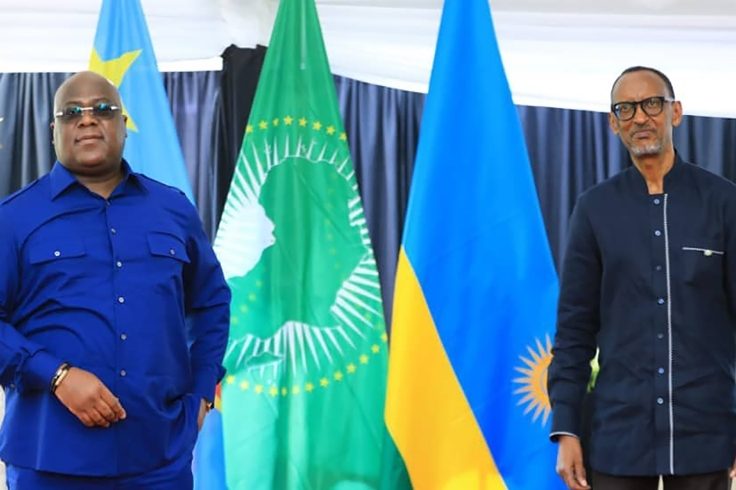
The timing is no accident. Eastern Congo has endured decades of armed conflict, and the current chapter remains particularly bruising. Kinshasa has long accused Rwanda of backing the M23 rebel group and of exploiting the country’s vast natural resources for Kigali’s benefit. Rwanda flatly denies those charges, maintaining that its security concerns stem from armed groups that continue to operate out of Congolese territory. The two narratives have coexisted in mutual hostility, and the region has paid the price in displacement, death and economic ruin.
Against that backdrop, Tshisekedi’s new comprehensive defence doctrine reads as both a military roadmap and a political statement. It tells the world, and perhaps more importantly tells Congolese citizens, that Kinshasa is no longer content to be a passive recipient of international goodwill or a stage on which foreign powers play out their own interests.
Five Pillars, One Vision
The doctrine is structured around five core priorities. The first is the development of an independent Congolese strategic outlook, essentially the cultivation of a national security mindset that draws from Congo’s own history, geography and interests rather than importing frameworks from elsewhere.
The second pillar focuses on building stronger surveillance and threat-anticipation capabilities. In practice, this means investing in the kind of intelligence infrastructure that allows the state to identify and respond to dangers before they escalate into full-blown crises, rather than scrambling after the fact.
Third on the list is digital and information sovereignty, a priority that speaks directly to the realities of 21st-century conflict. Information warfare, cyberattacks and the manipulation of digital narratives are now as dangerous as artillery in many contexts. For a country with Congo’s mineral wealth and geopolitical significance, control over its own data and communications infrastructure is not a luxury. It is existential.
The fourth pillar is perhaps the most philosophically ambitious: a commitment to African solutions for African security crises. The idea that the continent should resolve its own conflicts without outsourcing authority to distant powers is not new, but it rarely comes packaged with this level of institutional weight behind it.
Rounding out the doctrine is a call to reinforce republican ethics within the armed forces and security services. Military capability without institutional integrity has a habit of turning inward, and Tshisekedi appears aware that any credible defence posture must be grounded in a professional, accountable force.
CHESD at the Centre of Change
The venue for this announcement was deliberate. CHESD, alongside the Higher School of Military Administration, has spent the past decade quietly shaping the minds that run Congo’s security architecture. In ten years, the two institutions have trained 1,692 civilian and military officials, a number that represents a meaningful shift in how the country thinks about strategic education.
Tshisekedi was direct about the college’s role. “The College of Higher Studies in Strategy and Defense is far more than a training institution,” he said. “It is a school of discernment, anticipation and responsibility; a place where the Republic learns to see far ahead, to think rightly and to decide sovereignly.” Those words carry weight when spoken by a head of state who is simultaneously managing an active conflict in the country’s east.
The ceremony also marked the close of the 2025-2026 academic year and the opening of the 2026-2027 session, giving the event a dual significance as both a retrospective and a forward-looking moment for Congolese strategic education.
A Regional Moment Too
The presence of Burundian President Évariste Ndayishimiye at the ceremony added a regional dimension to what might otherwise have been a purely domestic event. Burundi shares a border with eastern Congo and has its own complex history with the instability that festers there. Ndayishimiye’s attendance signals at least a degree of regional solidarity around the doctrine’s pan-African security vision, even if the hard work of translating that vision into coordinated action still lies ahead.
Tshisekedi framed the intellectual core of the doctrine with striking clarity: “Sovereignty begins in the mind: through the ability to understand threats, to define our vital interests and to choose, with full independence, the means to defend them.” It is a line that sounds almost philosophical, but in the context of a country that has watched foreign actors help themselves to its resources while its own armed forces struggled to hold ground, it lands with considerable force.
Words on Paper, or a Genuine Shift?
Defence doctrines are, by nature, aspirational documents. The gap between a government’s stated strategy and its ability to execute that strategy is where most such initiatives quietly expire. Congo’s security challenges are not theoretical. The country covers an area roughly the size of Western Europe, has limited road infrastructure, and faces armed groups that are often better funded and faster-moving than the national army. Building the intelligence networks, digital systems and professional culture that Tshisekedi describes will require sustained investment, political will and time, three things that are perpetually scarce in conflict settings.
That said, the doctrine does something important even at the level of rhetoric: it reframes Congo’s security situation as a problem the country owns and intends to solve on its own terms. For a nation whose narrative has too often been written by outsiders, that framing matters.
The diplomatic track has not been abandoned either. Kinshasa continues to pursue negotiations to end the eastern conflict even as it builds up its military posture. Whether those two tracks can be run simultaneously without one undermining the other remains one of the central questions hanging over the Tshisekedi presidency.
As Congo attempts to translate strategic vision into battlefield reality, the world is watching. So here is the question worth sitting with: can a doctrine rooted in sovereignty, intelligence and African solidarity actually change the facts on the ground in eastern Congo, or does lasting peace require the one thing no doctrine can provide, a genuine political settlement between Kinshasa and its neighbours?