




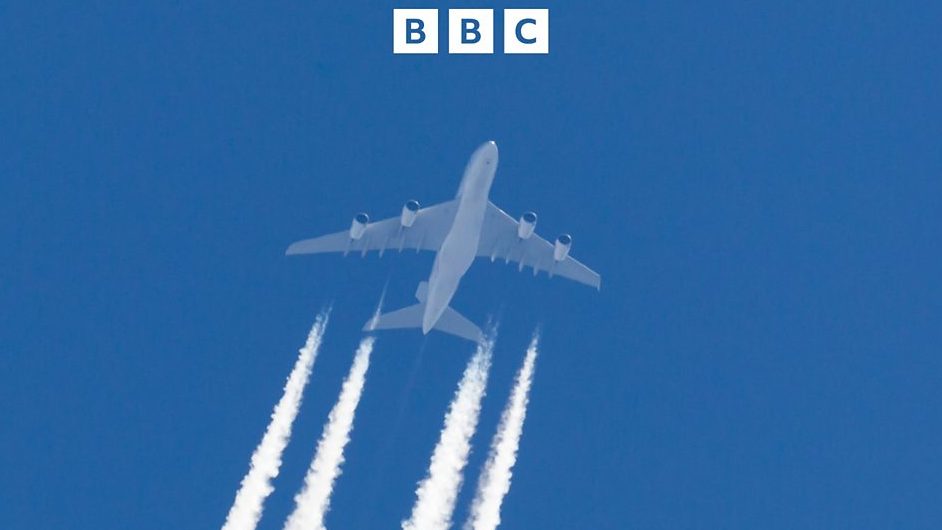
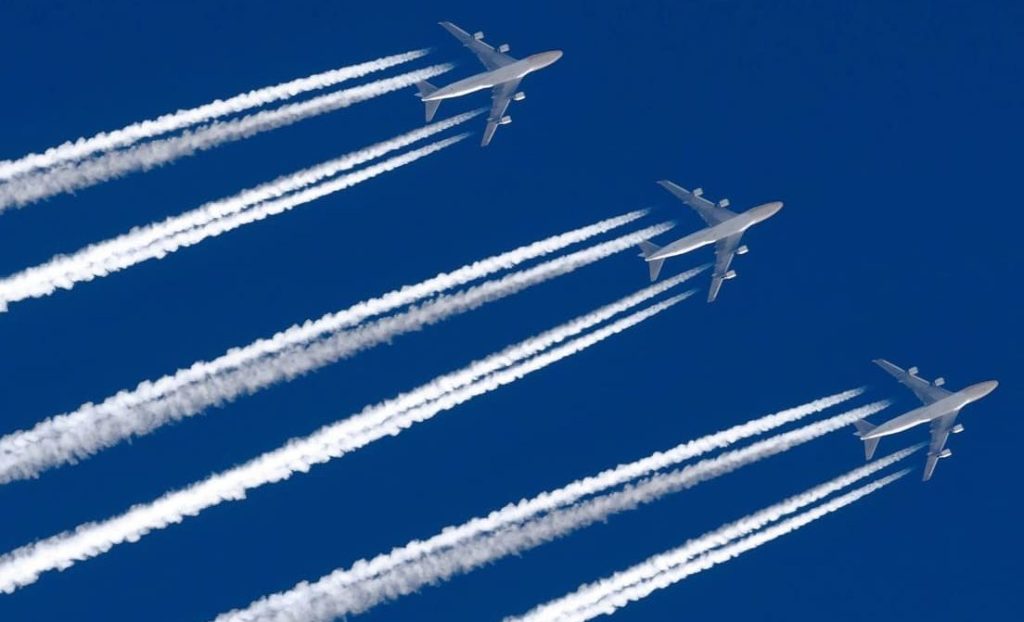
Look up on a clear day, almost anywhere in the world, and you will see them. White, wispy lines stretching across the sky like chalk marks on a blackboard, left behind by commercial aircraft moving through the upper atmosphere at altitude. For most people, they are nothing more than a casual curiosity, a visual proof that the world is connected by air travel. But for climate scientists, those same lines are a growing source of concern, one that rarely gets the attention it deserves in the wider conversation about what is warming the planet.
What Are Vapour Trails, Exactly?
Vapour trails, also known as contrails, form when hot, humid exhaust from jet engines meets the cold, low-pressure air of the upper atmosphere. The water vapour in the exhaust freezes almost instantly into ice crystals, creating those distinct white streaks. Under the right atmospheric conditions, meaning air that is already sufficiently cold and saturated with moisture, these trails can persist for hours, spreading out into thin, wispy cirrus clouds that blanket large sections of sky.
That spreading is precisely where the problem lies. Ordinary cirrus clouds, natural or contrail-induced, act like a thin thermal blanket over the Earth. During the day, they reflect some sunlight back into space, which has a modest cooling effect. But at night, and often even during daylight hours depending on cloud thickness and coverage, they trap outgoing heat radiated from the Earth’s surface, pushing it back downward. The net result, according to multiple decades of atmospheric research, is a warming effect on the climate system.
A Bigger Footprint Than Carbon Alone
Here is the part that surprises most people. When researchers assess aviation’s total contribution to atmospheric warming, contrails and the cirrus clouds they generate may actually account for a larger share of the warming effect than the carbon dioxide that aircraft directly emit. CO2 persists in the atmosphere for centuries, so its cumulative effect is immense over time. But contrail-induced cloudiness is a short-lived, high-intensity warming force that acts quickly and continuously, every single day that aircraft are flying.
This duality makes aviation a uniquely complex problem in the climate space. Address carbon emissions alone, and you are only solving part of the puzzle. A BBC deep-dive into the science of tech and everyday life recently brought this issue back into public focus, highlighting just how underappreciated the warming impact of vapour trails remains outside of specialist circles.
Why the Aviation Industry Has Been Slow to Act
The challenge for airlines is not simply one of willpower or regulation. Contrail formation is highly sensitive to atmospheric conditions that vary enormously from route to route, altitude to altitude, and hour to hour. A flight path that generates heavy contrail coverage one morning might produce almost none the following day, depending on temperature and humidity at cruising altitude. This variability makes it genuinely difficult to build consistent mitigation strategies around the problem.
There is also an economic tension at play. One of the most promising short-term solutions involves rerouting flights to altitudes or paths where contrail formation is less likely. The trouble is that those alternative routes are often less fuel-efficient, meaning airlines would burn more jet fuel, emit more carbon, and spend more money, all to reduce a warming effect that does not yet appear on any regulatory carbon ledger. Until contrail warming is formally priced into aviation’s environmental accounting, the business case for voluntary rerouting is a hard sell to shareholders.
New Technology Is Entering the Picture
Progress is coming, slowly but unmistakably. A growing number of research partnerships between airlines, meteorological agencies, and technology companies are working to build real-time contrail prediction systems. The concept is straightforward: use satellite data and weather modelling to identify atmospheric zones where contrails are likely to persist and warm the climate significantly, then route flights around those zones, even if it adds a few miles to the journey.
Early trials, particularly in European and North American airspace, have shown genuine promise. Some pilots have already been given contrail-avoidance data as part of experimental flight planning tools, and the results suggest that relatively minor adjustments to altitude or routing can dramatically cut contrail formation on specific flights. The fuel penalty in those trials has been modest, typically less than a one percent increase in consumption per flight, which changes the economic calculation considerably.
Sustainable Aviation Fuel and the Bigger Picture
Sustainable aviation fuel, widely known as SAF, is another variable worth watching. Research suggests that SAF burns cleaner than conventional jet fuel at a particle level, producing exhaust with fewer of the tiny soot particles that act as nuclei for ice crystal formation. Fewer nuclei means contrails that are less dense, shorter-lived, and potentially less warming. SAF is not a silver bullet, and its current availability at scale remains limited, but its contrail-related benefits add another layer of value beyond its direct carbon savings.
The aviation industry currently accounts for around two to three percent of global CO2 emissions by volume, a figure that sounds manageable until you factor in the altitude-related warming multipliers that make aviation’s total climate impact considerably higher. Contrail warming is central to that multiplier effect, and it is one reason why some climate scientists argue that aviation’s real contribution to global warming is closer to four or even five times what raw CO2 numbers suggest.
What Passengers Can Do Right Now
Individual travellers have limited control over which altitude a pilot selects or what fuel a specific airline loads. But demand-side pressure works. Airlines that are transparent about their contrail mitigation research and SAF uptake deserve recognition, and choosing carriers that publish detailed environmental data sends a clear signal through the market. Flying less is, of course, the most direct lever any individual holds, though it is also the most politically charged and personally complicated recommendation in travel writing.
Night flights tend to generate more net warming through contrails than daytime flights, because the cooling effect of reflecting sunlight back into space disappears after dark, leaving only the warming effect of trapped outgoing radiation. If you have flexibility in booking, morning departures in many regions correspond with atmospheric conditions that are less conducive to persistent contrail formation. These are marginal gains, admittedly, but in a system as massive as global aviation, marginal gains at scale add up quickly.
A Sky-High Problem That Needs Ground-Level Urgency
The science connecting those beautiful white lines to genuine atmospheric warming is well-established, even if public awareness has not caught up. Aviation sits at the intersection of economic ambition, technological innovation, and planetary responsibility, and the contrail question captures all three tensions at once. Policymakers who have spent years crafting carbon pricing mechanisms and emission trading schemes are only now beginning to grapple with how to account for non-CO2 warming effects, contrails included.
The good news is that the tools to address contrail warming are more readily available than many of the solutions required for decarbonising heavy industry or shipping. Smarter routing software, cleaner fuels, and better atmospheric data are all within reach. What is needed now is the regulatory will to make contrail warming a formal part of aviation’s environmental ledger, not a footnote acknowledged in specialist journals and then quietly ignored at the policy table.
Next time you look up and see those white threads stitching the sky together, consider what they represent: the extraordinary achievement of connecting the world by air, and the equally extraordinary responsibility that comes with it. The sky is not free. So here is the question worth sitting with: if airlines could cut their total climate impact significantly through smarter routing with only a marginal cost increase, should governments make that a legal requirement rather than a voluntary experiment?