











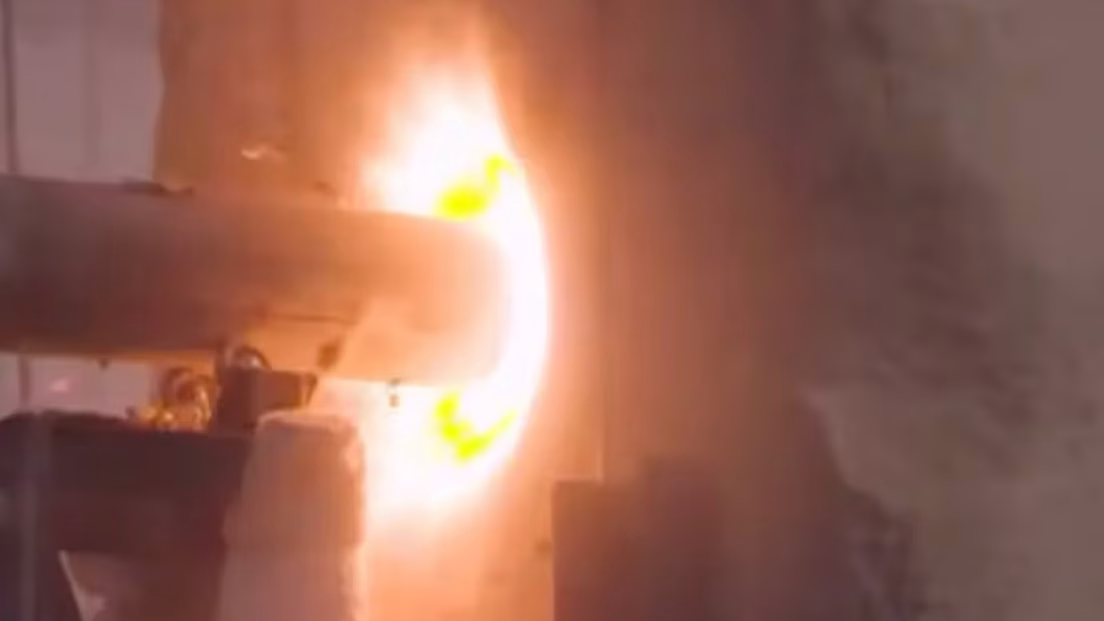
In a California quarry earlier this year, a small team of engineers stood before a towering wall of white granite, one of the hardest, most impermeable materials on the planet. Then they switched on something that made the rock irrelevant. A plasma-powered tunnel boring machine roared to life, its three torches spinning at the front of a cigar-shaped body, generating a stream of superheated plasma that reached 27,000 degrees Celsius. For context, the surface of the Sun sits at roughly 5,500 degrees Celsius. The granite did not stand a chance.
Igniting a Rocket Underground
Troy Helming, founder and chief executive of EarthGrid, describes the moment the torches light up as something close to igniting a rocket. The noise is considerable at first. Then the plasma torches settle into their work, spinning within a rotating head and producing that extraordinary heat in a focused, violent stream. During the January test in California, the machine bored through three metres of solid granite, a material that conventional boring technology treats with significant caution and considerable expense.
What makes EarthGrid’s approach genuinely different is the mechanism it uses to clear debris. As Helming explains it, the machine creates a tornado, a violent vortex inside the tunnel that sucks away the material the plasma has destroyed. At high enough temperatures, that material is not dust or chips. It is lava. The machine liquefies rock and removes it. Helming admits he got emotional watching it happen for the first time after ten years of working toward that moment. That kind of reaction is hard to fake, and harder still to dismiss.
Why Going Underground Has Never Mattered More
The timing of this technology arriving at commercial viability is not incidental. Across the world, engineers and governments are rethinking where they put critical infrastructure, and the war in Ukraine has accelerated that conversation dramatically. Russia’s conflict with Ukraine has demonstrated, in brutal and practical terms, how exposed above-ground facilities are to drone strikes. Power substations, telecommunications towers, data centres, anything sitting on the surface is a target that a relatively cheap unmanned aerial vehicle can reach.
Engineering firms are now telling researchers and journalists alike that demand for undergrounding, the process of moving power lines, fibre optic cables, and other critical systems below the surface, is growing. The logic is straightforward: you cannot drone-strike what you cannot see or reach. Underground infrastructure is not invincible, but it is dramatically harder to attack and far more resilient to the kind of asymmetric warfare tactics that have defined recent conflicts.
The problem, historically, has been cost. Conventional tunnel boring is slow, expensive, and deeply disruptive, particularly in urban environments or through hard geological formations. Granite, the material EarthGrid tested against in California, represents some of the most challenging ground a conventional boring machine can encounter. Plasma tunnelling, if it scales reliably, changes the economics of that calculation in a meaningful way.
What Could Actually Move Underground
Helming has spoken openly about the range of interest EarthGrid has received since its technology began attracting attention. Companies have approached the firm about using the machine to install power cables and fibre optic lines underground. There is also interest from those looking at pipelines, for water, natural gas, and even ammonia, which has growing importance as a potential hydrogen carrier in clean energy systems.
The breadth of that interest tells its own story. This is not a machine with one narrow application. It is a tunnelling platform that could theoretically serve telecommunications companies trying to protect their networks, energy utilities looking to harden their grids against both weather and warfare, and logistics operators working on next-generation pipeline infrastructure.
The Engineering Challenge That Remains
Despite the excitement around the California test, scaling plasma tunnelling from a quarry demonstration to a fully operational commercial service involves substantial engineering work. Boring through three metres of granite in a controlled test environment is a proof of concept, not a production pipeline. The machine will need to handle varied geology, operate over much longer distances, and do so at a cost that genuinely undercuts conventional alternatives.
That said, the physics are clearly sound. Plasma at 27,000 degrees Celsius will melt rock. The vortex debris-removal system works. The core concept has been validated in the field, not just in a laboratory. For an industry that moves slowly and cautiously, that is a meaningful threshold to have crossed.
The Bigger Picture: Infrastructure Built for an Uncertain World
There is something worth sitting with in the broader context here. The world spent decades building infrastructure above ground because it was cheaper, faster, and easier. That calculus made sense in a relatively stable geopolitical environment. It makes considerably less sense now. Climate change is intensifying storms that topple power lines. Geopolitical instability is making above-ground facilities targets rather than assets. Cybersecurity threats are one thing; a physical drone strike on a transformer station is another category of problem entirely.
Moving critical systems underground does not solve every vulnerability. It creates new ones, including maintenance challenges and flooding risks. But it removes a category of threat that is becoming increasingly relevant, and it does so in a way that conventional above-ground installation simply cannot match.
EarthGrid’s plasma boring machine is one piece of a much larger puzzle, but it is a striking one. The ability to tunnel through granite at temperatures hotter than the Sun, clear the debris as lava, and do so faster and potentially cheaper than existing methods is not a minor engineering footnote. It is the kind of capability shift that could quietly reshape where and how the world’s most vital systems are built.
The question worth asking now is this: as drone technology and geopolitical instability continue to evolve, how much longer can governments and utilities afford to leave their most critical assets sitting above ground, visible and exposed, when the technology to protect them by going underground is finally catching up?