






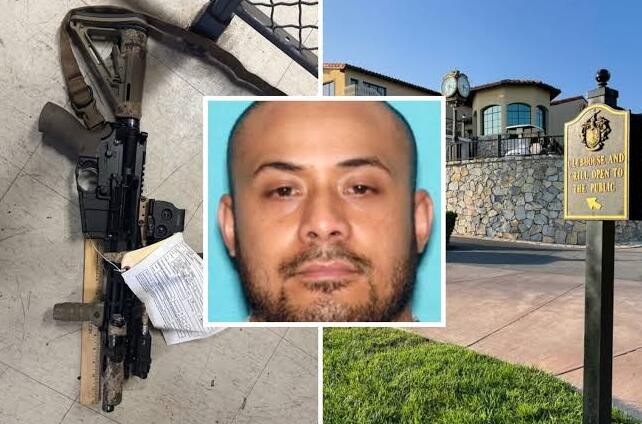
Federal agents didn’t stumble onto this one by accident. On July 31, 2026, law enforcement officers observed a man behaving in ways that set off every alarm in the security playbook near Donald Trump’s golf course in Rancho Palos Verdes, California, ahead of a presidential visit. That man, now identified as 38-year-old Jeanine John Taele, was spotted wearing an earpiece and recording security personnel as they swept the property. What followed was an arrest that has since grown considerably more serious, with authorities now piling on additional charges that paint a deeply unsettling picture.
What Federal Agents Saw That Day
There’s suspicious behavior, and then there’s what Taele was allegedly doing. According to authorities, he wasn’t simply wandering near the perimeter like a curious passerby. He was actively photographing and filming federal security agents who were conducting advance work around the golf grounds. The earpiece detail is particularly striking. It suggests either coordination or an attempt to monitor law enforcement radio communications, though investigators have not publicly confirmed which.
The location matters enormously here. Trump’s Los Angeles-area golf course in Rancho Palos Verdes is not a casual stroll-up destination. Security protocols around presidential properties, especially ahead of visits, involve layers of federal, local, and private security personnel working in tight coordination. Someone conducting what looks like counter-surveillance in that environment is going to attract very serious attention, very fast.
The Weapons Charge That Changes Everything
An arrest for suspicious behavior near a presidential property would already be a significant story. But the revelation that Taele faces a charge of possession of an unregistered short-barreled rifle moves this from a security concern into federal criminal territory with a much sharper edge.
Short-barreled rifles, often called SBRs, are tightly regulated under the National Firearms Act. Owning one without proper federal registration is a serious felony offense in the United States, carrying penalties that can include years in federal prison. The presence of such a weapon in the context of what looked like deliberate surveillance of presidential security raises questions that investigators are clearly working through carefully.
As reported by The Guardian, authorities have been releasing new details about the ongoing investigation in phases, suggesting the case is still actively developing and that additional facts may yet emerge.
The Bigger Picture: Presidential Security in 2026
This incident doesn’t exist in a vacuum. It lands at a moment when security around high-profile political figures has become one of the most scrutinized topics in American public life. The layers of planning, intelligence, and physical security that surround a sitting president are extraordinary, yet incidents like this one demonstrate that determined individuals can still get dangerously close to the edges of those protective rings.
What makes the Taele case particularly worth watching is the combination of factors at play. The apparent pre-planning implied by the earpiece, the active filming of security agents, and the presence of an illegal weapon create a profile that federal prosecutors will almost certainly treat with the utmost seriousness. Each element on its own could be explained away with some effort. Together, they form a pattern that is very difficult to dismiss.
How Advance Security Teams Operate
To understand why Taele’s alleged behavior triggered an immediate response, it helps to know how presidential advance security works. Before any visit to a property, federal agents conduct what are called advance sweeps. They assess access points, establish secure perimeters, identify potential threat vectors, and brief local law enforcement. Anyone monitoring that process from the outside and recording it would be gathering information about vulnerabilities, timing, and personnel positions. That is precisely the kind of intelligence that would concern any serious security operation.
The fact that agents spotted Taele during one of these sweeps and acted quickly enough to detain him before any presidential visit took place is a credit to the alertness of the security teams involved. But the incident also raises a fair question about how many people might engage in similar reconnaissance activity without being noticed.
What Happens Next for Taele
As of August 5, 2026, Taele faces charges including possession of an unregistered short-barreled rifle alongside the initial counts stemming from his arrest near the golf course. Federal weapons charges alone carry substantial sentencing guidelines, and depending on what investigators continue to uncover, the legal picture could become even more complicated for him.
Authorities have indicated that the investigation is ongoing, which typically signals that federal prosecutors are building toward a more comprehensive case rather than simply processing an isolated incident. Whether any additional suspects or connections are involved remains to be seen, though officials have not publicly suggested that this extends beyond Taele at this stage.
The case will almost certainly wind through the federal court system given the nature of the charges and the location involved. Federal prosecutions of this type tend to move deliberately, with grand juries and extensive discovery processes that can stretch across many months.
A Pattern Worth Watching
Golf courses have an odd place in the security landscape surrounding Trump. They are large, semi-public properties with extensive perimeters that are inherently more difficult to secure than, say, a traditional government building. The sprawling fairways and open terrain of a course like the one in Rancho Palos Verdes present a genuinely complex challenge for protective details.
This isn’t the first time a Trump-affiliated property has become the focal point of a security incident, and it likely won’t be the last. The recurring nature of these situations puts real pressure on federal security agencies to adapt their strategies continuously, closing gaps before someone with more sophisticated planning or worse intentions finds a way through them.
The Taele case, still unfolding, serves as a stark reminder that the work of keeping political figures safe never fully stops, even when the cameras aren’t rolling and the crowds aren’t gathered. It happens in the margins, in the quiet advance work, and sometimes in the arrest of a man with an earpiece and an illegal rifle standing where he absolutely should not have been.
What does it say about the current threat environment when federal agents are catching individuals conducting apparent counter-surveillance at presidential properties? And what, if anything, should the public know about how often incidents like this one are stopped before they ever make the news?