

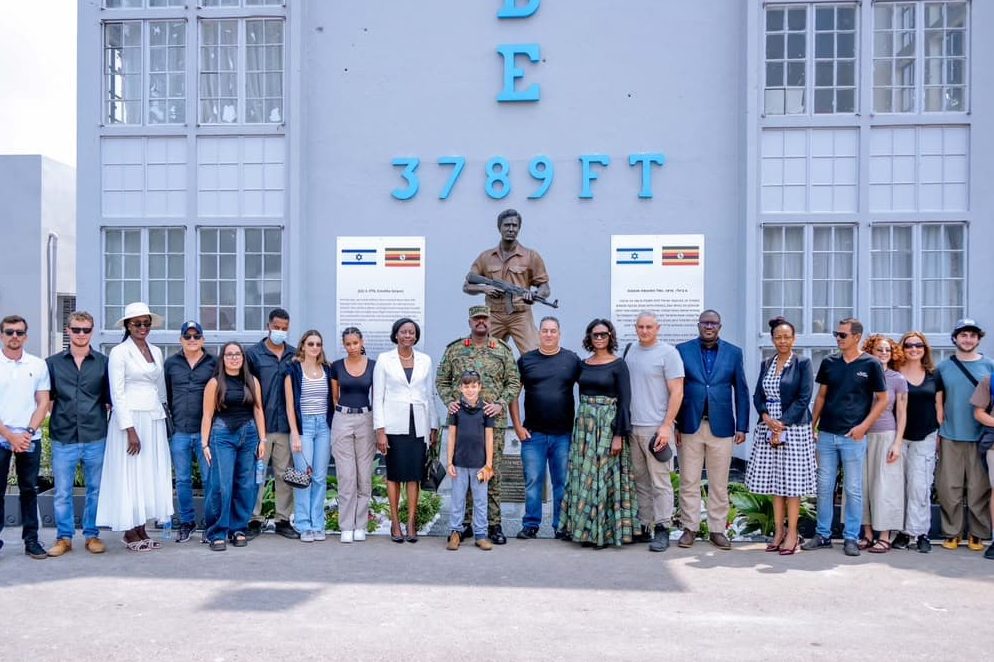





At the old terminal of Entebbe Airport, where the echoes of a daring midnight raid still linger in the walls, Uganda’s military chief General Muhoozi Kainerugaba stood before an Israeli delegation on Saturday and pulled back the curtain on something rare in African diplomatic history: a memorial built not for a native son, but for a foreign soldier who died on Ugandan soil fighting for the lives of strangers.
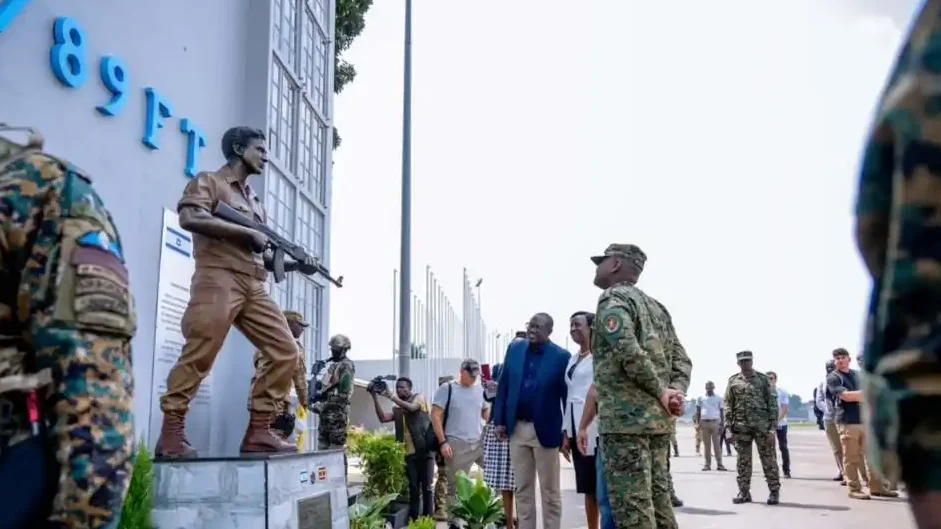
The monument honors Lieutenant Colonel Yonatan “Yoni” Netanyahu, the commander of Israel’s elite rescue force during the Operation Entebbe raid of July 4, 1976. Yoni, as he was widely known, was the only Israeli soldier killed that night. He was also the elder brother of Israeli Prime Minister Benjamin Netanyahu, a fact that has kept his name alive in global consciousness for decades.
A Raid That Rewrote the Rules
To understand why a memorial like this matters, you need to go back to the summer of 1976. A hijacked Air France aircraft carrying predominantly Israeli and Jewish passengers was diverted to Entebbe, Uganda, under the protection of Idi Amin’s government. For seven days, over a hundred hostages sat under armed guard at the old terminal building while negotiations dragged on and the world watched.
Israel’s response was surgical, swift, and almost unbelievable in its ambition. A force of elite commandos flew over 4,000 kilometers under cover of darkness, landed at Entebbe, and extracted the hostages in under 90 minutes. The operation became the stuff of military legend, studied in war colleges and dramatized in films for generations afterward. But for all its success, it came at a cost. Yoni Netanyahu was shot during the operation and died from his wounds, the sole Israeli fatality of the mission.
The Ugandan soldiers who defended the terminal that night also died. Hostages lost their lives too. It was, for all its strategic brilliance, a night soaked in grief on multiple sides.
Muhoozi’s Words: Reconciliation, Not Revisionism
General Kainerugaba did not shy away from the complexity of the moment. Speaking at the ceremony, he described the memorial as a bridge between two nations shaped by a night neither can forget. “It is a great honor and privilege to join you at this historic site as we unveil this monument to Lieutenant Colonel Yonatan ‘Yoni’ Netanyahu, the courageous commander of the Israeli rescue force whose leadership and ultimate sacrifice during the Entebbe raid of 4th July 1976 has become an enduring symbol of courage, duty, and selfless service,” he said.
He was careful, and notably generous, in acknowledging every party touched by the tragedy. He paid tribute to the innocent hostages who perished. He recognized the Ugandan soldiers who fought that night, noting they acted “in what they believed was a justified cause.” That line matters. It is a quiet but pointed way of separating the soldiers from the political regime that placed them there, drawing a clear line between modern Uganda and the brutal rule of Idi Amin.
Kainerugaba also made a point that cuts to the heart of why physical memorials still matter in the age of digital archives. “Monuments are more than stone and bronze,” he said. “They preserve memory, teach history, and inspire future generations.” That is not a throwaway line. It is a philosophy of public memory that many governments would do well to adopt.
What the Memorial Signals Between Uganda and Israel
The unveiling is not purely a gesture of historical sentimentality. It sits within the context of a warming relationship between Kampala and Jerusalem, and it signals something deliberate about where Uganda’s current leadership wants that relationship to go. Hosting an Israeli delegation at a site that was, for years, a symbol of tension between the two countries, and then planting a permanent monument there, is a conscious act of diplomatic repositioning.
For Israel, the memorial carries deeply personal weight. Yoni Netanyahu has long been elevated to near-mythic status in Israeli culture, a symbol of the selfless soldier who does not come home. Having his name inscribed at the very site of his final mission, in a country where that mission took place, closes a historical loop in a way that no diplomatic communique ever could.
The Civilians Who Must Not Be Forgotten
One of the more understated moments of the ceremony was Kainerugaba’s explicit tribute to the civilian hostages who died during the crisis. It would have been easy to make the day entirely about military valor, about soldiers and strategy and sacrifice. He chose not to. The hostages who lost their lives were folded into the official remembrance, their memory described as “an important part of this solemn history.”
That inclusion matters. Operations like Entebbe tend to calcify into heroic military narratives over time, with the human cost absorbed into the mythology. Acknowledging those civilians by name, in principle, at the ceremony keeps the moral weight of the moment from being entirely swallowed by the drama of the rescue.
Nearly 50 Years in the Making
The timing of the memorial’s unveiling, coming as the world edges toward the 50th anniversary of the raid in 2026, is clearly intentional. Anniversaries have a way of forcing reckonings that ordinary days do not. They ask nations and individuals to look directly at the past rather than around it.
Uganda under Idi Amin was a willing host to the hijackers. Modern Uganda, represented here by its military chief, is now the country erecting a monument to the man who came to defeat them. That shift, measured in decades and lives and political upheaval, is itself a kind of history worth marking.
The old Entebbe terminal, once a scene of international crisis, now holds something it never did before: a physical acknowledgment that courage deserves to be remembered, even when it arrives uninvited and ends in grief.
As Uganda and Israel look toward the half-century mark of one of the twentieth century’s most dramatic nights, one question lingers: can a single monument do justice to a story this layered, or does it simply give future generations a place to start asking the right questions?